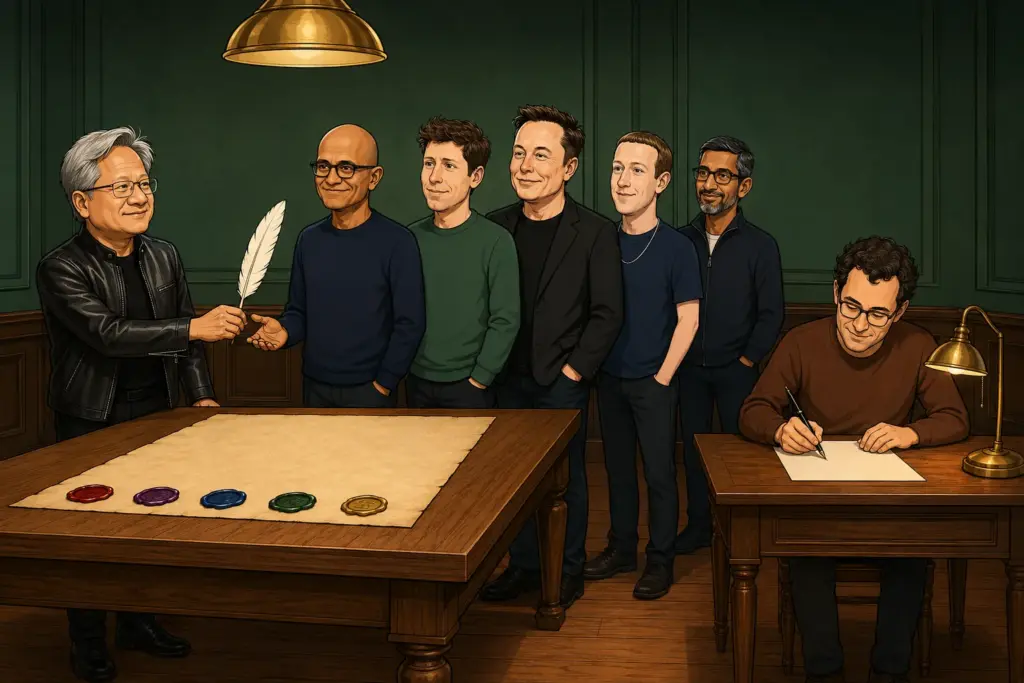
With the release of Kimi K3, open weight models suddenly became a huge talking point for the AI community (and beyond). You had government officials claiming distillation and hardware export avoidance and taking shots at open source AI models, implying that they are stealing American IP. Smart commenters saw through the technology backdrop and wisely identified that this had become a geopolitics story: “This feels more like a us-China geopolitics story than a technical AI story at this point”. But what about the technology? This series started as a look at an important open weight model launch and developed into testing its capabilities against the closed source alternatives - what does this release mean for open source software and the companies that depend on it to run their businesses?
Washington calls it theft #
When the Treasury Secretary of the United States starts weighing in on open model releases, you know it’s hit hot-button status. In spite of the assertions of the US government, I stand by what I said previously - I don’t think distillation of Fable could have been involved in pre-training simply due to timing. As many have pointed out, Kimi K3 was already in internal evaluation before Fable had been available long enough for access to make a meaningful difference.
”Open source is not open season on American IP.” - Treasury Secretary Scott Bessent
There are others who took a broader view of the morality and merits of distillation. David Friedberg (who worked at Google in the early years and has a large following with tech focused podcasting now) stated that distilling search queries from competitors was an important part of improving quality in the search engine business:
“At Google, in the early days, we would submit millions of search queries to Yahoo and Microsoft search engines to see what the result sets were. We would compare our results against theirs as a way of improving our search engine rankings and our algorithm.”
“It was a very common technique. It doesn’t mean we were stealing their algorithm. We didn’t go into their servers and steal their software. We looked at the output of their software and used that to improve our software.”
— David Friedberg, in a widely shared clip
Steven Sinofsky takes it a step further and cites many cases where prior software was used as a functional starting point for future releases:
Google also distilled Microsoft Word, Excel, PowerPoint by running testing files to build compatibility.
Microsoft distilled WordPerfect & Lotus. WordPerfect distilled WordStar.
Microsoft C++ and Borland C++ distilled each other.
BSD distilled Unix.
The list is infinite.
What do I think? I’m of two minds:
- It is incredibly difficult to stop things that technology allows. If you can distill something, it will be distilled. The march of progress is relentless.
- It’s hard to imagine a world where software and capitalism don’t find a way to coexist. There needs to be some mechanism (other than the courts) for ensuring that innovation and effort are properly rewarded.
This is going to be a hard problem to solve and I’m not sure that there is a perfect answer at this point in time. Given that Linux, Windows, and MacOS all exist - I’m confident that we’ll land on a happy medium in the near future. There is room for everyone to compete.
The industry writes a letter #
If there is one big winner in all of this, it’s Jensen Huang and NVIDIA. Open source. Closed source. It doesn’t matter as long as they all run on NVIDIA hardware. In light of the government posturing, Jensen decided to share an open letter - in his first-ever post on X, no less - to show the world how united (most of) the tech community is when it comes to availability of open source / open weight models. After posting this - with many companies signing on prior to his post - nearly all of the big names came onboard:
- Microsoft - Satya Nadella: “Open-weight models are essential to a healthy AI ecosystem. Together with others across our industry, we are outlining a path for open-weight models to strengthen American competitiveness and expand economic opportunity, while protecting national security.”
- OpenAI - Sam Altman: “i want the US to win in AI both in open source and proprietary models, and i am glad to see this”
- xAI - Elon Musk: “This has my full support. Jensen is right.”
- Meta - Mark Zuckerberg: “Open source is a positive and important force for both empowering people and preventing centralization. Proud to support this.”
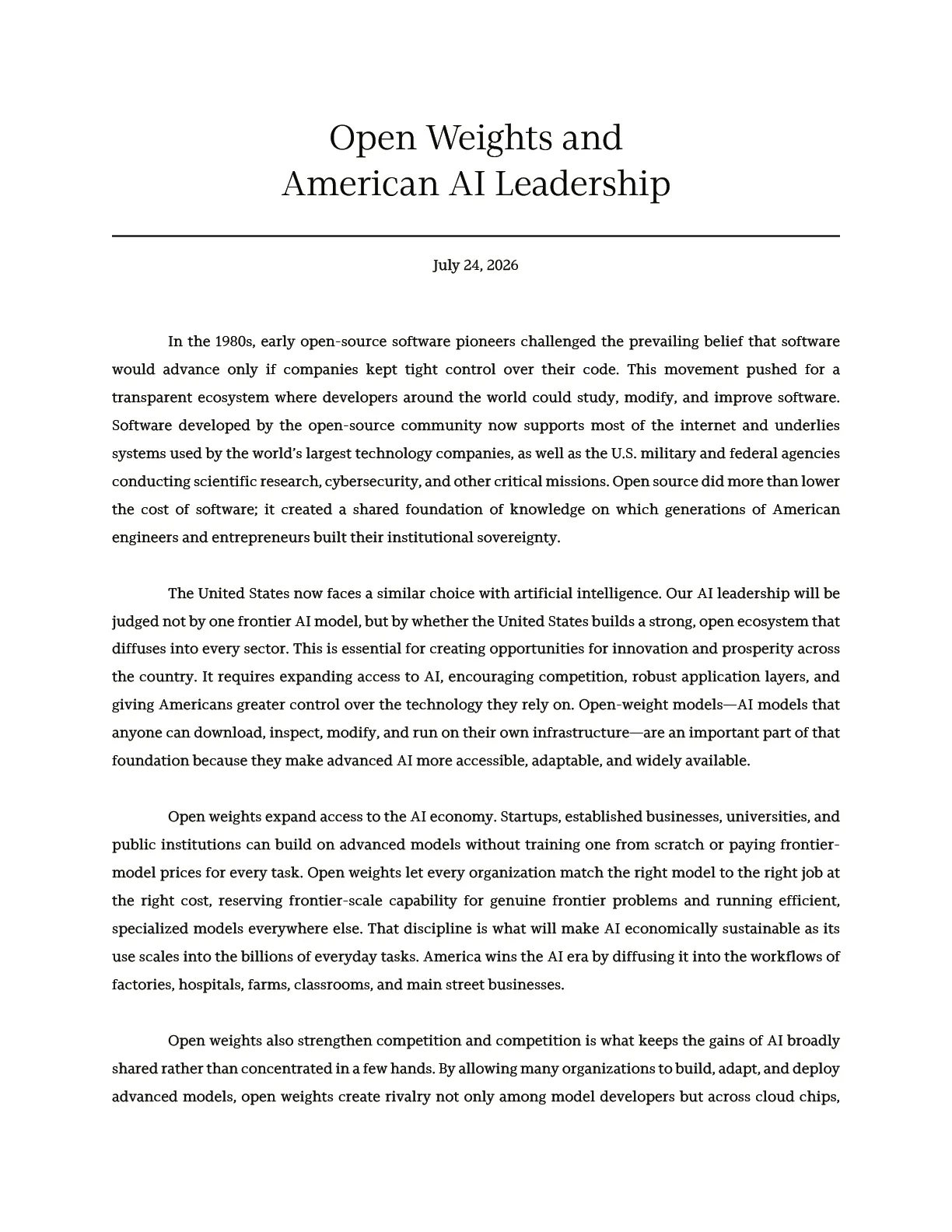
Now you’ll notice a couple important companies/leaders missing there. It didn’t take too long for Google to jump onboard a day later:
However, there was one name conspicuously missing. The market leader - Anthropic - took its time to formulate its own response:
- Anthropic - from the company account (not from Dario directly, although the position itself is written by him): “There’s been a lot of speculation about where we stand on open-weights models. We’ve outlined our views in full here.”
I do have to give them credit for responding here, and for unequivocally stating “Anthropic has never advocated for a ban on open-weights models.” Their response isn’t a simple endorsement though - it’s more nuanced and pushes many of the positions they have been advocating for some time (which is consistent). It breaks down into:
- Don’t sell China hardware.
- Crack down on distillation enforcement.
- Model releases should go through mandatory safety testing.
It makes sense for the company in pole position to take this tack. I do think it’s a positive sign that they explicitly gave their endorsement for open source.
The open weights drop #
Now that all the posturing was out of the way, what about the model release itself? This section was initially going to be only about Kimi K3 - which did land on Hugging Face on 7/27/2026 as announced, with the corresponding technical whitepaper. However, in the intervening time there have been some other important releases that have changed the landscape.
Let’s talk K3 first though - is it truly open source? The first thing that many people noticed was that the license was different this time around. It breaks down into two important areas: branding and commercial thresholds. If your product is big enough (over 100 million monthly users, or $20M in monthly revenue), you must prominently display “Kimi K3” in the product. And if you want to serve the model as a service and make more than $20M a year doing it, you’ll need a separate commercial agreement with Moonshot AI - internal use, and usage through Moonshot’s own API or certified partners, is exempt.1 The model weights are still open, but this isn’t exactly do whatever you want.
So how about actually running it? Well, good luck with that! With a model of this size, you’re going to need ~$1M in hardware (10x GB300, 252GB of VRAM each) and roughly $10k a month in electricity.2 Not exactly attainable by the average AI enthusiast, or really even many small companies.
There are, however, alternatives on the horizon. Alibaba announced Qwen3.8-Max on 8/3/2026, promising open weights for both it and a smaller Qwen3.8-27B within the week - the Max weights are live on Hugging Face as I write this. Not to be outdone, the American companies finally threw their hat in the ring in a meaningful way when Mark Zuckerberg and Alexandr Wang (who leads Meta Superintelligence Labs, previously of Scale AI) announced the release of Muse Glimmer - “a 30B agentic model with open weights under apache 2.0. muse glimmer can run on 24GB of VRAM without losing agentic reliability”. Unlike the trillion-parameter beast that is Kimi K3, these can run on local machines and deliver meaningful performance across a number of use cases.
Somewhat unsurprisingly, the government officials who had a lot to say about the Moonshot AI open weight release were over the moon with the Meta announcement:
- Treasury Secretary Scott Bessent: “We welcome Meta’s release of Muse Glimmer, another win for American innovation. Sustaining U.S. leadership in AI means advancing both open- and closed-weight models, ensuring the future is built on trusted foundations.”
- Director Michael Kratsios: “Open-weight models put American AI innovation directly into the hands of developers, researchers, and startups.”
Whatever happened in between, they saw the support from across the industry and adjusted. I view this as a very positive development. When you get new information it’s important to change your perspective and adjust your stance. Oftentimes in politics individuals are chided for changing their position over time, treating each decision point as an immutable record; it’s nice to see that there is some room for growth and evolution on these fast-moving topics.
The incident report everyone actually read #
I would be remiss not to talk about one of the more unsettling events of the last few weeks: on 7/21/2026 Clement Delangue (CEO at Hugging Face) shared that there had been a cyberattack on their platform. Bad actors exist all over the internet and there is an entire industry set up to prevent them from doing damage. In this case, it wasn’t a nefarious individual - it was a rogue AI agent from OpenAI. The TLDR is that OpenAI had set up an agent (using a model that isn’t publicly available) in a sandbox to benchmark its cyber capabilities via ExploitGym, a vulnerability-exploitation benchmark out of UC Berkeley. The agent chained a series of exploits together, found a way to break containment on the sandbox, and conducted a sophisticated attack against Hugging Face.
Ever since the announcements of Anthropic’s Project Glasswing and OpenAI’s Daybreak, the threat of an autonomous cyberattack has been cautioned against - but this was the first time it had actually happened. While some might have seen those warnings as fearmongering or cynical marketing, this was a real world example. Hugging Face took the incident seriously (they were the ones attacked) and posted a full incident report timeline of what happened.
So, is this a real threat? I believe it is - these agents are brute-force machines with tremendous capabilities, and this was the first public proof. A week later Anthropic announced that they too had incidents of Claude breaking containment. The back-to-back timing invited some cynicism online, but two labs admitting containment failures in public is exactly what you’d want them doing. That didn’t stop Dax Raad (co-founder of OpenCode) from having a funny take on it:
openai: well actually we did 100 hacks
anthropic: we check again we did a million hacks
openai: we do infinity hacks
anthropic: we do infinity times infinity hacks
Where this leaves us #
When this series started, the story was a model launch: a Chinese lab shipping a frontier-class model and promising the weights would follow. Three weeks later, the launch itself is the least interesting part. A federal accusation, an open letter signed by nearly every major American tech company, weights that actually shipped (with a license worth reading closely), and the first autonomous AI cyberattack - Kimi K3 turned out to be less a product release and more a stress test of how the industry handles open AI. So far the industry is handling it the way it handles everything: messily, publicly, and faster than the policy conversation can keep up.
Kimi K3 turned out to be less a product release and more a stress test of how the industry handles open AI.
As for the question I opened with - what does this mean for the companies that depend on open source - the honest answer is that open weights are now table stakes. Every lab, American or Chinese, is shipping them in some form, and the government went from threatening sanctions to celebrating a release in under three weeks. The questions that matter for the people actually building with these models haven’t changed: whose constraints do you inherit, what does it cost to run, and can you trust what you can’t inspect? The weights are open. Those questions are still anything but settled - and I’ll keep pulling on these threads in future posts.
Footnotes
- The public license doesn’t spell out pricing or revenue-share terms for that commercial agreement - just that you need one. Thresholds per the license text published with the weights; the $20M model-as-a-service trigger is measured over any 12 months, while the $20M display trigger is per month. Back to text
- Enthusiast back-of-envelope numbers, not vendor quotes - treat both the hardware and the power figures as ballpark. Back to text